


Nail fungiations (onychomicosis) legs, dermatophites (up to 96%), less frequent molds and maya (about 4%)), a disease developed as a result of damage to nail plates with musical mushrooms (96%).Infection ends the micose that ends along the foot of the legs of the feet.Here finds favorable conditions for development - growing humidity and nutrients.The structure under the influence of pathogens is broken and the color of the nail plates varies.It occurs in their full destruction over time.
Onychomycosis is not only a cosmetic defect, but also a serious disease under the control of a dermatologist and exposed to adequate treatment.
Mushrooms in the legs are celebrated in millions of people around the world.About 5% of the total population suffers from onychomycosis.Most diseases are common in people with 50 to 60 years.Every second person is sick in this age group.The treatment of pathology is difficult for them due to the presence of somatic pathology, mainly vascular and endocrine.Men are more sick than women.Older people get sick faster than youth.Children rarely suffer from serious diseases.With AIDS, the disease has an atypical picture.
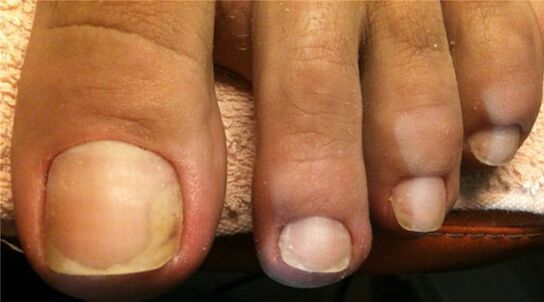
Substitutions of the OnyComycosis
The cause of the onychomycozis is a different type of fungus: Dermatophyte, yeast or mold mushrooms separate or combinations.
- Dermatophites mushrooms are up to 90% of all onychomycosis.They are represented by Trichophyton's fungi (most T. Rubrum and T.Mantagrofitis. Interdigitale).Most, nail plates on the feet are affected by Trichofyton Rubrum.Dermatophites are common in countries with a moderate climate.
- The gender of the canus onhomycoz in the legs rarely causes.Make up approximately 3% of all onychomycosis.In addition to Candida Albicans, S. Tropicalis, S. Parapsilos and S. Guilliermondi, such as Guilliermundi, are also diseases.
- Most mushrooms themselves cannot lead to nail fungus.Only a few of their species are independent pathogens - these are not low in pathogenicity to dermatophytes, Hyalinum and S. Dimidiatum (Nattrassia Magniferee).Onychomycozis in the legs, Scopulariopsis Brevicaulis, are molds like ASSpergillus SPP., Pirenochaeta Unguis-Heominis, Alternaria SPP.et al.The infection is most common in countries with a warm and humid climate - tropics and subtropics.
Epidemiology of the disease
Most of the onykomycosis is anthropophilic infection.They are sick and spread the infection mainly.
Dermatophyte mushrooms
The source of reservoirs and dermatophytic mushrooms, pathogens are a patient who is transmitted directly with contact or personal belongings.The infection continues almost always the nails on the legs, but also the nails, and the nails, both clear and secretly (michaosle forms).The risk of infection is repeatedly in one of the family members in one of the presence of a disease.
Mushrooms infected shoes, clothes, clothes, canvas, towels, washing clothes, etc.Transmission for and so on.Contributes to the legs of mutual fungi, walk barefoot in common areas.Pathogens live in wooden floors and floors for a long time.
Maya-like fungi
Canus's yeast mushrooms are Saprophyte flora and always live in a person's skin.A good immune system is limited by the growth of pathogens.Antibiotics, contraceptives, glucolicoids and cytostatics, endocrine pathology (often diabetes Mellitus) and a number of diseases in a range of immune systems.Explosive fungi enters the human body with the products rich in the patient's own skin and mucous membranes with nails or carboidrates.
Molds
Molds live on the ground.Their disputes fall into products, items and environmental facilities.Nedimatophites are not spread among people.

Risk factors for the development of the disease
For mushrooms, a hereditary tendency for dermatophytes, men's sexual, old age, vascular diseases, diabetes, diabetes, immune deficiency, other dermatomicosis are characterized by the presence of other dermatomicoses.
Canx Canus's canus is characterized by incompatibility with infection of the yeast-like fungus, increased temperature and humidity, immune disadvantage, blood glucose, nail damage and personal hygiene rules.
Molding is characteristic of severe immune failure and nail injury to infection with mushrooms.
Risk groups
The risk group on the development of Onyxomycosis includes:
- Dressing rooms, shower, saunas, etc.
- Professional athletes (swimmers, players, athletes, etc.).
- Other groups using military personnel and ownership shoes.
- Male faces.
- Age is more than 60 years.
Contribute to the development of fungus in the legs:
- To wear tight, tight neighboring shoes.
- Increased sweating or dry legs.
- Injuries and abrasives, legs, ingrown nails, etc.
- Location in age and hot climates.
- Walk barefoot in public places.
- Availability of skin diseases in which the nail keratization (psoriasis, icthyosis).
- Diseases such as diabetes, immunization, immune failure, blood circulation of low extremities, blood diseases, corticosteroids, antibiotics and sites.
- Genetic tendency.
Ways to develop fleet mushrooms
There are several ways to penetrate mushrooms to the nail plate:
- Distal or distal-lateral (free or side by side).
- Surface (direct nail plate).
- Proximal (Alto -Gut).
The distal-lateral way of mushroom reputation
Trichofyton Rubrum is characteristic of rubrum mushrooms in prestigious distal or distal landing.The pathogens are presented to the nail plate from the free edge (distal) or side areas (side alternative).The main inflammatory process occurs in the nail field, which is developed by developed cells.The stingy layer of the skin on the free edge (hyper-guts), resulting in the nail plate, and abrasion (onicolysis).
In addition, the infection spreads in the direction of the hole and gradually penetrates the broken nail plate.By damaging the matrofa, the general dystrophic onyology occurs.
Hyperkeratosis of the nail bed is observed in chronic eczema, psoriasis, warts, red flat licken.

The surface path of the mushroom was spread
Mushrooms are trichophyton mentagrofites.Interdigitale is more aggressive than the heated structures, which are more than other dermatophites of nail plates.First of all, the White Surface affects the outer part of the nail plate, which causes the development of monicomycosis.Fungi under the influence of keratinaz enzymes gradually seizes all layers of the nail plate, the transfer of the nail plate.Basically 1 and 5 toes are affected.While walking are those who are subject to the biggest traath of shoes.Inside the disease, 1 and 4 intercal folds are affected.
The surface form of the surface of the onychamycosis is believed to be caused by mushroom-humanatoofites.
Proximal fungal distribution path
In a nail plate of fungi - there is a third way through the proximal nail reel and nail bed.The defeat starts from the skin in the area of the nail scrolling area thickened and eroded from the nail surface.In addition, the final part of the matrix is involved in the process in connection with the damage of nail bed, nail rubbing, violations and cracks.By entering the nail plate of pathogens, the nail gets white opaque color in time.Over time, the full destruction and loss of the nail plate was recorded.It is more common in patients with HIV, which spread the infection through blood vessels.
Features of damage to the maya-like mushrooms of Canus
The kingdom of the kingdom, who damaged the fungus of Canakhia, begins with the inflammation of the rolling water (located near the hole).Its edition and thickening are noted that this causes cuticle from the surface of the plate.In addition, the fungi freely leads to the matrix and nail bed, the nail causes the tank of finger over time.
Features of damage to fungi by Incorpoons
Nail damage to mushrooms without non-foreign mushrooms are second.Molds (Often Skytalidium SPP.) Already affected nail - put the space between cracks, nail bed or vessolless ships.Next, the slow destruction of hypercerator and nail plate is developing.
Clinical forms of monikomycosis in the legs
The legs have several forms of monikomycosis:
- Distal-lateral.
- The white surface.
- Proximal.
- General dystrophic.
Distal-lateral submarine onychomycosis in legs
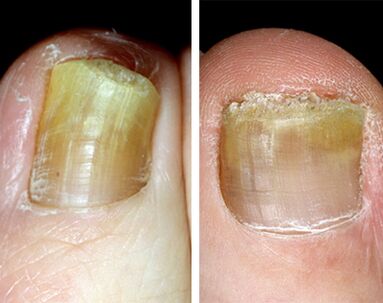
This form of the disease is most common.In most cases, the cause of onycchomycosis is especially in the trichofyton rubrum.Pathogens penetrate the free edge on the nail plate and side of side marches.Perenophaeum develops hyperkeratosis, resulting in finger tissues (onicolysis), loses transparency, starting to start taking the mindset or yellow.With the development of underwater hyperbuilding, the nail plate was thickened.With the advancement of the disease, the lesion focus, as shown by yellow strips, is expanding towards the hole.Over time, all nail plates and matrix are involved in a pathological process that causes the destruction and destruction of the nail over time.
In older people, hyperkerators (thicknesses), onychogroosis (thickness and deformation in the form of poultry claws) or coilonichia (concave deformation) are often observed.Their nails are often affected by flora - dermatophites, molds and even bacteria.
The surface (white) form of monikomycosis in the legs
The white surface in the legs is the second largest distribution form of the onychomycosis.His reason is mainly trichophyon mentagrofites.In the nail plate, with part of the upper (pre -rsal) part, as well as intersigitalize, which includes a nail plate through several types of fungus-hectofits.Basically, the nail on the first finger of the foot, the lesser - fifth.
First, the small white spots and stripes appear on the surface of the stripes, which is the result in a growing surface.Gradually, the color is yellow.The surface of the nail is empty, rough, dust, easily jumps.The thickening and separation from the nail bed does not occur.
The form of proximal submarines of onyophosis in the legs
This form of Mikos is rare.Make up approximately 3% of all onychomycosis.Reason, Candida albicans and Trichophyton are the yeast of Rubrum.Before the inflammation of the nail polish periods of periods.It's swelling, red, bright.The incision is removed and the infection penetrates the last part of the matrix and nail bed, is due to the violations and cracks on the nail plate, natural brightness and the loss of the cloud.Gradually, the nail is destroyed, in severe cases disappear.In the legs, this form of monikomycosis is often in patients infected with HIV.
General dystrophic form of onyoMycosis in the legs
This form of onychomycosos is developing with a more frequent length (chronic course), the reason is more Trichofyton Rubrum and Candida albicans.At the same time, the nail plate, the bed and matrix participated in the pathological process.The excuse of the nail occurs as a result of the development of underwater hyperperactory.Over time, the nail plate is destroyed and the newly grows or weakly growing because of the affected matrix.

Types of damage to nail plates
There are 3 options for onychomycosis:
- Normotorophy.
- Hypertrophic.
- Atrophic.
Normotrophic type of monikomycosis in the legs
Normotrophic type, infection is localized in the upper layers of the nail plate.The thickness and color in the disease does not change, but the stains and strips appear in depths.The color of the nails varies from white to the yellow color.After a while, the stains and strips are combined.The area spreads to the entire nail plate, except the month.Breaking and bending are not observed.Sometimes a slightly discharge of free edge is marked.A treatment with adequate treatment is possible.
Type of hypertrophic onykomycosis in the legs
This type of onyomycosis is most common.As a result of the development of underwater hypercerator, the nail plate is significantly thickened, deformed and gloss.Nails become uneven, dull, brownish-gray color and collapses.The area of the month is not affected.The disease gives sick material concern.The development of onychogrifose in elderly patients is noted - nails are thickened, stretched and bent as a bar of birds and bend.
Atrophic tip onyokomycosis in the legs
An atrophic (checked) type of type, a lot of space from nail bed, many gaps occur, grow, grow, and turn into a white or yellow-white.The surface remains smooth for a long time.Partially destroyed over time.
Signs and symptoms of nail fungi
Often the change in the nail begins free (distal) or lateral (lateral) edges.
Change of color.With onychomycosis, a change in the color of the nail plate is the first sign of the disease.It becomes transparent, often loses brightness, overlap with mushrooms, brown, brown, green and even black.
Thickening.As a result of the development of underwater hyperpertoose, the increase in the number of heated masses lead to the thickening of the nail.
Crushing and destruction.As a result of the vital activities of fungi, the first time the nail plate crashes and is completely destroyed over time.
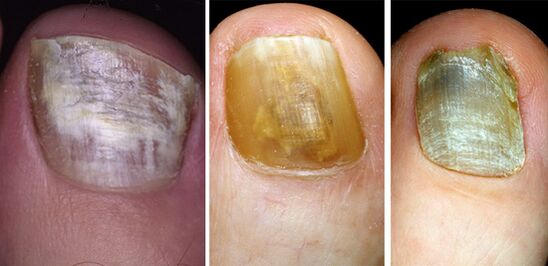
Features of nail damage with different types of monkomycosis
Different types of fungal diseases have their own characteristics of the nails.The main types of pathogens are Trichofyton Rubrum (70 - 90%) and Trichophyton Mentagrophytes V. Einterdigital (8 - 30%).Candida Albicans, Molds Mushrooms, T. Mentagrofites, T. Verrucosum, T. Verrucosum, T. Tonsuras and T. Violasum, EpidermoFitton Flocosum, Tichophyton is less common.Schoonleini.
OnyoMicosis on the legs with rubrofitia
Rubrophyte in the Russian Federation is 70% of all the microbes.The legs in the disease are most affected (usually a skumous dry type).An irreplaceable satellite of a rubrophytion of the legs is the nails on their legs.With MyCosis, the distal rogue of onyomycosis is usually developed, hyperkerator is characteristic of hypermakers, a few fingers and often one fingers more than one.The disease continues without special subjective sensations.While wearing shoes occur with pain and anxiety, onickeratosis, Onichogrifosis and an ingrown nail pronunciation.The source of infection is often in the patient's family.
Often, related onycchomosis are recorded: Trichophyton Rubrum and Candida Albicans, Trichophyton Rubrum and Molds.It is important to assess the cultural study.
Onychomycosis on their feet with t.Mentagrobs mushrooms.V.interdigitalie
Mushrooms T. Mentagrofayts.V.interdigitale affects the skin of the legs and nails.EpidermoFittitosis is 10-30% of the michaz of all feet.
The upper (dorsal) part of the nail plate with the disease is affected.Onychomycoz's surface white form usually develops.The pathological process is mainly involved in 1 and 5 bars (subject to the biggest trauma by shoes during a walk) and 1 and 4th layers.The transfer of infection occurs when using a common bath, shower, sauna, pool, beaches and pools.
Onyomycosis in the legs by damaging fungus mushrooms like a breed in cancer
This mycoz uniform in the legs is rare.Form less than 3% of all onychomycosis.Often the disease is celebrated in people with chronic generalized candidiasis.In nails, as a rule, start with inflammation of the periology roll, located near the hole.Its edition and thickening are noted that this causes cuticle from the surface of the plate.In addition, the fungi freely in the matrix and nail compartment (proximal sub-nibble form), the illegal and cracks are displayed, the loss of natural brightness and clouds, brownish-brown color.Gradually, the nail is destroyed, in severe cases disappear.

OnyoMicosis on the legs caused by molds
Plastic mushrooms are included in the spaces between the already affected nail - cracks, nail beds or vessels.Next, hyperkeratosis develops and slows down the stained nail plate in black (skytalidium spp.) Or green or gray (skopulariop services) color.
The diagnosis of onychomycosis
The diagnosis of Onychomycosis is based on the date of epidemiological history, the clinical picture of the disease and the laboratory research method.
The nature of the material (mushrooms or other pathogens) are being built in the microscopic examination.The identification of fungi is built with a microscopy of a clean culture with a microbiological examination (a nourishing material product).The process is hard work, success in half of the success is achieved.The correct collection of the correct material from affected nails is the key to successful microbiological research.
Differential diagnosis
In only half of patients with dermatologists, the form of nails and color changes and color diseases.OnyComycosis Ekzema, psoriasis, repetitive syndrome, pachionichia, Dariya disease, plain lyen, Norway, distinguish from bacterial lesions.